
This article originally appeared on Inside Climate News, a nonprofit, non-partisan news organization that covers climate, energy, and the environment. Sign up for their newsletter here.
Plans are advancing on the Gulf Coast of Texas for an enormous seawater desalination plant which, if built, would be part of one of the largest water infrastructure developments in the country.
Unlike other projects, this one wouldn’t belong to the public, but to a private, foreign water supplier.
IDE Technologies, an Israeli water treatment giant that operates some of the largest seawater desalination plants in the world, was awarded the contract for the landmark Harbor Island project on Corpus Christi Bay this summer by the Nueces River Authority, a small state water agency.
“For our company, globally, this is Project One,” IDE regional sales director Mark Ellison told the NRA board of directors at its September meeting. “Our top priority.”
A 60-year-old, formerly state-owned firm, IDE has built more than 400 desalination plants in 40 countries, according to the company.
In Texas, rapid growth and intensifying droughts have stretched present water supplies to their limits. Generations of state leaders have touted the promise of seawater desalination plants, which would produce freshwater from the salty Gulf of Mexico. But Texas still awaits its first such facility.
Today, IDE’s Harbor Island project is the largest of five seawater desalination plants planned in the state.
The development of seawater desalination in Texas would mark a breakthrough for the state, unlocking a new, abundant source of water from the ocean. But it would come at a high cost to consumers, and would mark a dramatic transfer of the public water supply to private ownership.
“We’ve been here for a decade getting ready to get this started,” said Ellison, a former state water official during a presentation last month to officials in Corpus Christi, a major industrial port and the nation’s largest export hub for crude oil. “We’re moving very actively to get going.”
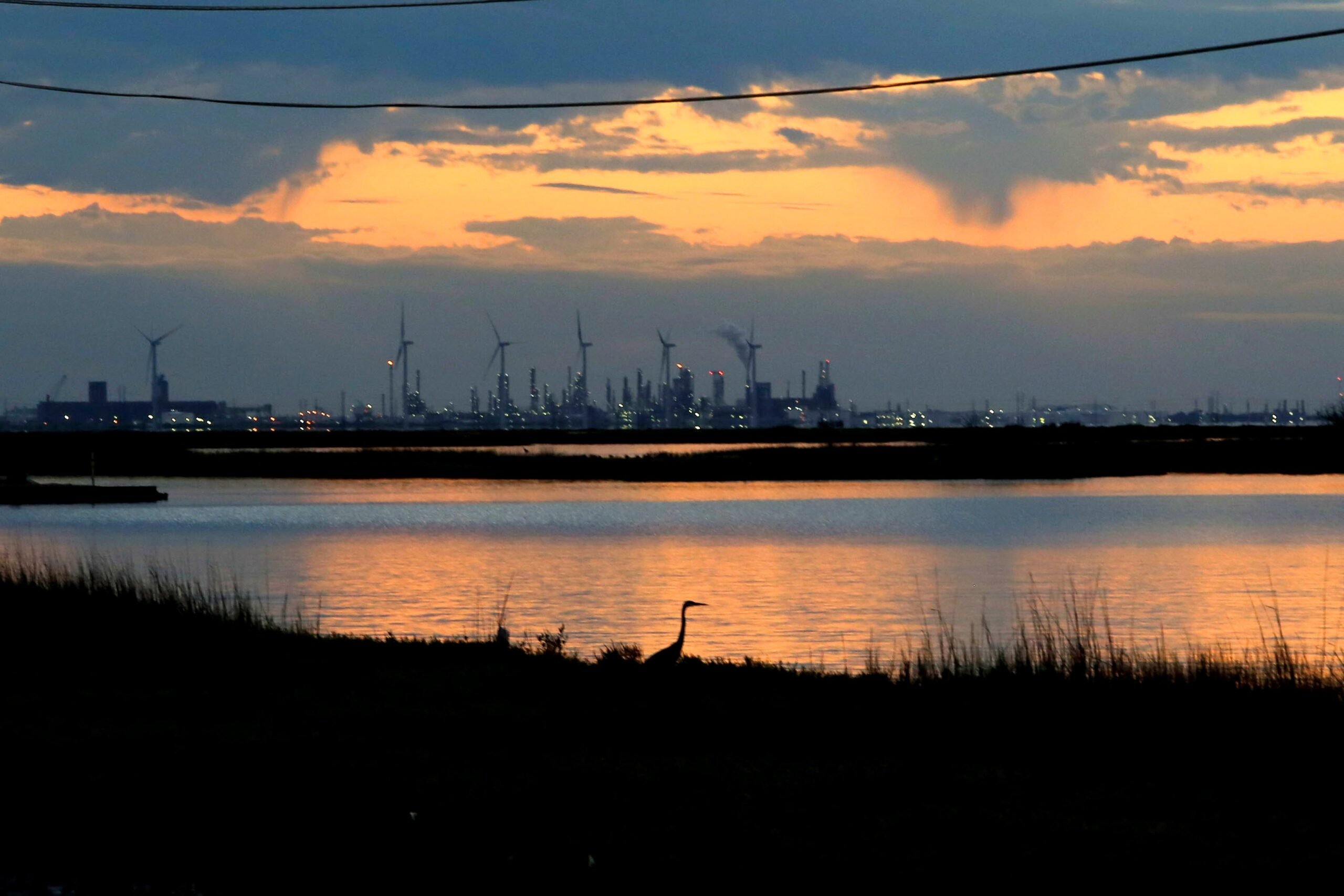
It would be the largest desalination plant in the Western Hemisphere, according to IDE, eventually producing up to 100 million gallons per day of freshwater. It would include nearly seven miles of two-story-tall sub-sea tunnels, plus a vast system of pipelines and pump stations running more than 200 miles inland to the booming towns and cities of south Central Texas.
IDE plans to finance and build the plant while the NRA develops the pipelines, with a combined estimated price tag of $6.4 billion.
In cost and complexity, it would rival the iconic aqueducts, pipelines and dams of the American West.
“It would be one of the more ambitious projects in U.S. history,” said Drew Molly, a former chair of the American Waterworks Association and chief water officer for the city of Houston.
On Sept. 23, the Texas Commission on Environmental Quality approved its final permit for the Harbor Island plant.
Elsewhere on the coast, IDE announced plans in April for another desalination plant near Brownsville that would produce 50 million gallons per day. Nearby, a small public utility, the Laguna Madre Water District, is also developing its own 5 million gallon per day plant.
A Canadian company, EPCOR, announced plans last year for a 27 MGD desalination plant near Houston. A plastics manufacturing complex, CC Polymers, plans to boot up a 9 MGD plant early next year and, like IDE’s Harbor Island facility, wants to begin selling water to the city of Corpus Christi, which has tried for more than a decade, to no avail, to build its own desalination plant.
“The private sector realizes that water is a scarce resource,” Molly said. “And the private sector wants to capitalize.”
It goes beyond desalination. Across the state, private and investor-owned water projects have cropped up in recent years, aiming to pump large volumes of groundwater and sell it to booming cities and subdivisions, too.
That bucks the traditional model in Texas, where water supplies are typically owned by public agencies like cities, towns, river authorities or utility districts.
“Water infrastructure should be owned by the community, not the property of a private company that is making a profit,” Molly said.
Officials in the city of Corpus Christi, where Molly previously served as head of the water department, ultimately rejected plans to build a municipally owned desalination plant, put off by its surging cost estimates.
Now, Corpus Christi plans to start buying water next year from the desalination plant at CC Polymers, the plastics manufacturing complex, which is jointly owned by companies from Taiwan, Indonesia and Mexico.
Corpus Christi also plans to buy water at an undetermined price from IDE’s plant at Harbor Island.
“I’m quite reluctant to move in that direction,” said Roland Barrera, a member of Corpus Christi City Council. “It’s better that the public agency owns the system.”
High Price of Private Water
IDE plans to announce a price of water from its Harbor Island plant in January. After that, Corpus Christi will decide whether or not to sign a long-term purchase contract, which would require the city to pay for water whether it uses it or not.
Barrera, the council member and owner of an insurance business in downtown Corpus Christi, worries what will happen when the city’s contract expires in 20 or 30 years. Communities may have to pay whatever new prices the companies set.
“It’s too much uncertainty,” Barrera said. “It’s going to be very expensive.”
Desalinated seawater is already the priciest water supply option that exists. The law requires public utilities to provide water at the cost of service, while private projects seek to maximize profits.
A private project wouldn’t be eligible for the low-interest government loans that typically finance the public sector. Costs to borrow money in private equity markets are nearly twice as high. That’s a big reason why privately financed water projects remain rare, said Mary Grant, water policy director for the nonprofit Food and Water Watch.
“It’s not very common, just because it’s very expensive,” she said. “Borrowing on the municipal bond market is a lot cheaper.”
The higher cost to finance the project will ultimately be passed on to customers who are already burdened by rising water prices, Grant said. Household water bills in the U.S. grew faster than inflation, grocery prices or median household income in recent years, according to a Food and Water Watch report released last month.
“Privitization will only exacerbate this affordability crisis,” Grant said.
Others disagree. While some costs of private projects are higher, others are lower, said Corpus Christi City Council member Gil Hernandez.
“Our cost to borrow the money is cheaper, however our cost to build things is much more expensive,” he said. “We tend to pay two-to-three times as much as the private sector for construction.”

Around the world, seawater desalination plants are owned and operated by companies, not by governments, said Hernandez, a former naval officer and sales manager at Coca-Cola Co.
Ellison, the head of IDE in Texas, said in an interview last month that private ownership protects communities from financial risks associated with enormous infrastructure projects.
“The private people put skin in the game,” Ellison said. “That’s why we want to make good bets.”
Customers sign contracts with a guaranteed price of water before construction of a plant begins. Developers assume all risk if projects turn out costing more than initially envisioned, as happened in Corpus Christi, where feuding political interests dragged an ultimately fruitless process out for years.
“Politics are colorful down here, but we don’t do politics and drama,” Elison said. “We build plants.”
Desalination in Texas
Ellison joined IDE in 2015, but his role in the development of Texas’ desalination policy goes back farther than that.
With a bachelor’s degree in agricultural education from Texas A&M University, Ellison previously served as director of the Texas Emerging Technology Fund, a founding board member of the Texas-Israel Chamber of Commerce, special advisor to the Texas Water Development Board and as manager of strategic water initiatives in the office of Gov. Rick Perry.
Almost 25 years have passed since Perry launched an initiative, in 2002, for demonstration of large-scale seawater desalination in Texas. In that time, California and Florida saw their first plants come online.
But in Texas, companies like Massachusetts-based Poseidon Water, Kansas-based Kiewit and Florida-based Seven Seas advanced project proposals that ultimately stalled, unable to compete with the low cost of water from Texas’ natural sources like aquifers and rivers.
“We have had very prolific rivers up to this point,” said Kyle Frazier, executive director of the Texas Desalination Association. “In the last 10 years, as the drought has become more persistent, the end users have started looking for other options.”
IDE began planning its first Texas project in 2015 at the Port of Freeport, where Dow needed water for a planned expansion of its chemical manufacturing complex. That project also stalled after Dow opted to expand its reservoir instead, said Sean Strawbridge, founder of a company called US Desalination, which is partnered with IDE on the project in Brownsville.
The model works best at scale, where large facilities can link to large water markets, said Strawbridge, a former CEO of the Port of Corpus Christi.
“Texas is a fragmented market,” he said. “It’s a very inefficient market because water has historically been left to small utilities.”
In contrast, Strawbridge pointed to Israel, where the government developed a national water pipeline grid and a single, large water market. In Israel, which gets the vast majorityof its domestic water supply from desalinated seawater, a treatment facility built anywhere can easily connect to customers everywhere.
That’s how Israel built a densely populated country with 15 million people, including the Palestinian territories, in the desert.
Israel, however, is about the size of the nine-county Greater Houston region. Building something similar in Texas would be a monumental endeavor, but that hasn’t stopped state leaders from trying.
“If a dry arid nation of 15 million people can solve for its water problems, there’s no reason why the great state of Texas, with 30 million people, can’t,” Strawbridge said.
“The Two Lone Star States”
IDE was there at the beginning when Israel first confronted its water problem, explained Lihy Teurstein, CEO of IDE Water Assets, during a panel discussion at the 2023 annual conference of the Texas Water Development Board.
After the country declared independence in 1948, immigrants began to pour into the arid region with few natural lakes, rivers or aquifers, Teurstein told the audience in Austin.
“Our first prime minister realized that with the growth in the country there’s gonna be a need for new sources of water,” she said. “That’s when IDE started to operate.”
The then-state-owned company built desalination plants that used crude thermal methods, which heat seawater and collect the freshwater that evaporates. At the same time, authorities began building the national water grid.
Israel barely got by, Teurstein said, recalling constant water conservation measures during her youth, until IDE pioneered new technologies in membrane filtration.
“The revolution for desalination was a membrane revolution,” Teurstein said. “It enabled the use of seawater for potable water at affordable prices.”
IDE was transferred to private ownership in the 1990s, opened its first membrane desalination plant in 2000 and began to export its technology around the world.

In Texas, Ellison joined the state Department of Agriculture in 1991 as assistant commissioner for marketing under Commissioner of Agriculture Rick Perry.
“He was an aggressive marketing guy,” said Larry Soward, who served as deputy agriculture commissioner at the time. “He was Jewish and I think responsible in part for Perry’s active interest in promoting Texas-Israel economic ties.”
Ellison and Perry made official visits to Israel in 1992 and 1996 to learn about agriculture and water management in the arid region.
“Perry said he sees us as the two Lone Star states,” Ellison later told the Texas Jewish Post. “We haven’t changed the star on the Texas flag to the Star of David yet, but who knows.”
Perry became governor in 2000, then appointed Ellison in 2005 as director of the Texas Emerging Technology Fund.
The two visited Israel again in 2007, when Perry received the “Friend of Zion” award. After that, Perry created the Texas-Israel Chamber of Commerce, which gave Ellison, a board member, its Chairman’s Award in 2008.
“Israeli companies, as they grow in that hotbed of entrepreneurship, eventually want to be able to break into the North American market,” Ellison told a local tech blogger at a Texas-Israel Chamber of Commerce event in February 2010. “Texas is a great spot with a great economy.”
Perry appointed Ellison as a special advisor on economic development at the Texas Water Development Board in January 2013. Later that year state lawmakers introduced legislation creating the State Water Implementation Fund of Texas (SWIFT), a flagship program of the TWDB to fund development of local water infrastructure.
“We’re taking measures to put in place financing for water infrastructure expansion,” Ellison told the Jerusalem Post in October 2013 when he led a delegation of officials and engineers from the Gulf Coast of Texas on a sponsored, weeklong tour and seminar showcasing Israeli desalination and water-resource technologies.
Texas voters approved the SWIFT program in November 2013, and in January 2014, Perry appointed Ellison manager of strategic water initiatives for the governor’s office.
In 2015, state lawmakers adopted legislation to streamline permitting of seawater desalination facilities “in order to avoid unnecessary costs, delays, and uncertainty and thereby help justify the investment of significant resources in the development of such facilities.”
That same year, IDE opened its small office on Congress Ave. in Austin, two blocks from the state capital, with Ellison at its head.
A new governor of Texas, Greg Abbott, took office. He visited Israel in 2016 and toured an IDE facility.
“The governor expressed his intention to partner with Israeli technology companies such as IDE to develop and deploy water solutions for Texas,” said an IDE press release in 2016.
Running Out of Water “Is Not an Option”
At the time, a handful of projects were proposed along the Texas coast, and policymakers were eagerly optimistic, said Todd Votteler, a former executive manager for the Guadalupe-Blanco River Authority.
“Everybody thought something was coming soon,” he said.
Even the Guadalupe-Blanco River Authority studied the possibility of building a plant at that time.
Planners believed that the state’s first seawater desalination plant would break regulatory and financial barriers to unleash a seawater desalination boom.
“I used to be in that camp,” said Robert Mace, a former deputy executive administrator of the Texas Water Development Board. “Now, we’ll see.”
Mace, now executive director of the Meadows Center for Water and the Environment at Texas State University, has listened to this conversation go on for more than a decade.
“When I was at the board, IDE would parade through,” said Mace, who left TWDB in 2017. “An associate with IDE, who used to be an upper-level official in the Israeli government, told us what we needed to do.”

The biggest hangup was the pipeline network, Mace said. The government in Israel has more authority over pipeline construction, he said. But in Texas, it means litigating eminent domain with hundreds of thousands of landowners.
One way to avoid that cost is to build the plant next to an industrial customer that will use all its water, like a refinery or chemical plant, without running pipelines to the nearest cities.
IDE built the largest desalination plants in India and China, both at refineries, Ellison told an audience at the Massachusetts Institute of Technology in 2015, and the company was planning similar projects in North America.
Industrial operators were starting to view water like they viewed power, Ellison said at the MIT conference. Every major industrial complex has back-up power sources in case the grid goes down—now companies were also looking for backup water in case drought dries up the public supply.
“They cannot afford to shut down,” Ellison said. “Running out of water is not an option. They need an uninterruptible supply.”
Rivalry in Corpus Christi
In Corpus Christi, industrial giants including Valero, OxyChem, Citgo, Flint Hills Resources and Cheniere Energy formed a working group in November 2014 to study the possibility of developing a private desalination plant.
But the group concluded that such a facility would be more affordable if it were built by the city government with low-interest public financing, specifically SWIFT loans from TWDB.
Corpus Christi took up the project, but it languished for years. In September 2020, the city invited 10 companies and partnerships, including IDE, to pitch project ideas.
“Texas and Corpus Christi in particular are a very attractive spot,” Ellison said in a presentation to the City Council. “Because of your proximity to the water, the power costs and proximity to a large customer base.”
The largest water user in the region at the time, Valero’s Bill Greehey refinery, was also the primary source of U.S. fuel exports to Israel, according to an analysis of data from Kpler, a trade data analysis company, provided by Data Desk. That includes military jet fuel and diesel provided under a Defense Department contract, according to a 2024 report by Oil Change International.
IDE proposed to partner with U.S. construction giant Kiewit to build a privately owned desalination plant that would sell water to the city. Other companies, including Poseidon Water, Seven Seas Water and CC Polymers, made similar propositions to build privately owned facilities.
The city, however, insisted on municipal ownership. Leaders of the nearby Port of Corpus Christi Authority, including CEO Strawbridge, disagreed. The port was pushing for a privately owned project at Harbor Island.
City officials were outraged in 2022 to learn that the port planned to seek state funding for the project, which could steal the water market from the city. The City Council adopted a resolution calling on the port to abandon the pursuit and to “end any and all attempts to become a water producer.”
Nevertheless, the port continued its pursuits. It sponsored a delegation of state and local leaders on a trip to Israel to visit IDE facilities later that year, learn about the national water grid and the public-private partnership method of development.
Port officials in Corpus Christi continued to advocate for a privately owned and operated desalination plant on Harbor Island.
“We have a good location, we have a permit, we’re working on the final parts of that permit,” said Port Commissioner Bryan Gulley at a March 2023 port event. “What we’re trying to do is pretty tiny compared to what they’re doing in Israel.”
City leaders continued to admonish the port for pursuing a competing project and Strawbridge resigned in May 2023. He later founded US Desalination, which announced plans this year to build the plant in partnership with IDE at the Port of Brownsville.
In an interview, Strawbridge said many milestones still lie ahead before the desalination plant near Brownville breaks ground. Those include early engineering work, permit applications, facility design, a power supply agreement and a pipeline system to add the water to public supplies in the Rio Grande Valley.
“The political support that the project has received has been overwhelmingly positive,” Strawbridge said. “We have to continue to demonstrate progress.”
The Harbor Island Project
After Strawbridge’s resignation in 2023, the port’s Harbor Island project idled.
Meanwhile, the city moved forward on its municipal desalination plant. In 2024, Corpus Christi invited developers to submit proposals. Kiewit, the construction giant that previously proposed to partner with IDE, applied alone.
IDE requested a 45-day extension on the submission deadline to develop a proposal in partnership with Shikun & Binui, the largest commercial real estate developer in Israel, but Corpus Christi denied the request.
Kiewit won the nearly $1 billion contract later that year.
The Port of Corpus Christi, in September 2024, received an unsolicited offer from a small, rural water agency, the Nueces River Authority, to assume responsibility for the Harbor Island project.
The executive director of the NRA, John Byrum, zipped around south and central Texas, telling small cities and utility districts about his plans to build an enormous pipeline carrying desalinated seawater inland from the coast, and offering an opportunity to reserve a portion of its supply, for a fee.
“It’s the one that won’t run out.”
Byrum collected millions of dollars in reservation fees, secured a lease for Harbor Island, commissioned early engineering services and hired lobbyists in Austin.
In August 2025, Byrum presented the Corpus Christi City Council with a chance to reserve 50 million gallons per day from the Harbor Island plant for a $2.7 million deposit. The City Council approved the payment.
The next month, in September, the Corpus Christi City Council cancelled its $1 billion contract with Kiewit.
Three weeks later, the NRA hired Civitas Engineering Group to develop a request for proposals for companies to build the Harbor Island desalination plant. The NRA issued the request in January 2026, but it was not made public.
“The Developer may finance the Project through a combination of private debt and equity,” said the 40-page document, obtained through a public records request in October. “Tax-exempt funding may or may not be available.”
After the NRA submitted the request, vendors asked for clarification of a number of questions related to the development, including where the funding for the initial phase of the project would come from.
The river authority said it had entered into preliminary reservation agreements with offtakers of the water and expects to have definitive water purchase agreements with municipalities and industrial customers as the primary source of funding. The NRA is also pursuing state and federal grant funding to help cover costs, an addendum states.
The prospective developers also wanted to know how much the reservation holders expected to pay for water. “They have been told that the average range of Seawater desal is between $10 to $15 per 1000 gallons,”
In May, the NRA selected IDE as its partner in the project.
“We are proud to partner with the Nueces River Authority and be part of developing a record-breaking facility and setting a standard for future projects in the US,” said IDE Water Assets CEO Teuerstein in a press release on June 1.
An Insurance Policy?
The NRA estimated the project at a gargantuan $6.4 billion—about half for the plant and half for the pipeline system. But the small agency lacked funds to move the project forward, officials observed at the June 25 NRA board meeting.
“Anybody that’s looking at these three months should have some real concerns,” said board member Dan Suckley at the meeting. “Conceivably, we’re out of money at the end of August.”
Instead, on Aug. 28, the TWDB convened a special, nine-minute board meeting to consider a $7 million grant for the Harbor Island project.
“This is a little bit of an unusual request,” said board member Brady Franks at the meeting. “How did it make its way to the board?”
“The governor’s office has directed the Texas Water Development Board’s executive administrator to award funding,” responded Kevin Smith, the TWDB’s south region manager.
The money would help the NRA develop the massive pipeline system for the project, Byrum said at the meeting. IDE would finance the desalination plant privately, he said.
“We are trying to keep pace with them,” Byrum said.
Byrum returned to the Corpus Christi City Council for the Sept. 1 meeting, with an update on the project. They still hadn’t secured full financing, Byrum said, but he was hopeful for help from the federal government.
“I believe they’re going to come through,” he said.
Soon, Byrum explained, Corpus Christi would need to sign a contract committing to purchase up to the 50 million gallons of water per day that the city had already reserved. The contract would require Corpus Christi to pay for the water whether it needed it or not.
Byrum assured the City Council that it would be needed. He displayed a graph showing 200 million gallons per day of unmet regional water demand by 2030.
“Those projections seem awfully high,” said City Council member Sylvia Campos. “How can we believe you?”
“You have to believe this,” Byrum said. “This is all you’ve got.”
The projections came from the state of Texas, he said.
Two weeks later, Byrum announced his resignation, days before the NRA board was scheduled to discuss his potential termination at its Sept. 25 meeting.
“It hurts,” Byrum said about walking away from the Harbor Island project. “It was a big part of what I was doing.”
The NRA planned to finance the rest of the pipeline project by signing water contracts with its customers in the months ahead, according to a handout provided to the Board of Directors at the meeting.
Ellison told the board that IDE hopes to select its general contractor in the coming months. In January, Ellison said, IDE planned to put a final price tag on water manufactured from the Harbor Island Plant.
The water, which eventually will have to be distributed far from Corpus Christi to cities near Austin, will be more expensive than any ground or freshwater, Ellison said.
“But it’s the one that won’t run out,” Ellison said. “Look at it as an insurance policy.”
The post How Texas Could End Up Paying Billions to an Israeli Company for Water appeared first on The Texas Observer.


